
The Isla Mujeres
Ethnographic Field School
About Isla Mujeres
A Small Island. A Remarkably Complex Field.
Isla Mujeres is a narrow Caribbean island just off the northeastern coast of the Yucatán Peninsula, across the water from Cancún. The island is only about seven kilometers—roughly four and a half miles—long and approximately half a kilometer wide, yet within that small geographic space are residential neighborhoods, tourism districts, fishing traditions, beaches, lagoons, businesses, schools, churches, health services, conservation areas, government institutions, and an extraordinarily active waterfront.
About 14,000 people live on the island itself; the 2020 Mexican census counted 13,174 residents in the Isla Mujeres locality, distinct from the larger municipality, which also includes communities on the mainland.
For IFS students, that combination is important. Isla Mujeres is geographically manageable enough for students to move through the community and conduct independent fieldwork, while socially complex enough to support research across health, tourism, conservation, migration, business, education, language, religion, politics, identity, and everyday life.
The island is beautiful. But for IFS, it is much more than a destination.
It is the field.
An Island in the Maya Caribbean
Human history on Isla Mujeres extends far beyond the modern town.
Before European arrival, the island formed part of the wider Maya world of the eastern Yucatán Peninsula and the Caribbean coast. Its location placed it within maritime networks connecting settlements, fishing grounds, trade routes, and religious sites.
Isla Mujeres became strongly associated with Ixchel, an important Maya goddess connected in historical traditions with medicine, childbirth, fertility, weaving, the moon, and other dimensions of life. Government and historical accounts describe the island as a place of pilgrimage and offerings associated with Ixchel before the Spanish arrival.
At Punta Sur, archaeological remains survive from the Late Postclassic period, roughly the fourteenth through sixteenth centuries. One restored structure is popularly known as the Temple of Ixchel, although archaeological scholarship is appropriately cautious about assigning a precise ritual function to every surviving structure. What is clear is that Isla Mujeres formed part of an active Maya cultural and maritime landscape immediately before European conquest.
When the expedition of Francisco Hernández de Córdoba reached the island in 1517, Spanish accounts described encountering female figurines or votive images. The Spaniards associated these figures with the name they gave the island: Isla Mujeres—Island of Women.
That Maya history is not simply archaeological.
Maya language and cultural identity remain part of the contemporary Yucatán Peninsula, and Maya speakers continue to live within the Isla Mujeres community and wider municipality. INEGI reported that 13.9% of the municipality's population age three and older spoke an Indigenous language in its 2015 intercensal survey.
For students, the result is a field in which ancient heritage, modern Maya identity, tourism, religion, government, and commercial representation of the past can all intersect.
War, Refuge, and the Founding of Modern Isla Mujeres
The permanent town familiar today developed much later.
The Caste War of Yucatán began in 1847, producing warfare, displacement, and major movements of people across the peninsula. Isla Mujeres became a place of refuge for Maya and Yucatecan families fleeing the conflict.
On August 17, 1850, the settlement of Dolores, the foundation of modern Isla Mujeres, was formally established. Federal historical accounts describe more than 250 Maya and Yucatecan settlers establishing themselves there after escaping the violence of the war.
Life on an island required adaptation. Fishing, maritime movement, local agriculture, trade, and collective organization became central to the developing community.
By the end of the nineteenth century, Isla Mujeres had become a defined permanent settlement rather than simply a seasonal stopping point for fishermen and mariners.
Migration has remained part of island life ever since. Modern Isla Mujeres includes families with deep multigenerational island roots alongside people who arrived from other parts of Mexico, Cuba, Argentina, and elsewhere—one reason migration and belonging have become subjects of IFS research.
Fishing, Cuba, Pirates, and a Caribbean Maritime World
The sea has always connected Isla Mujeres to places beyond the Mexican mainland.
Historically, Cuba was especially important. Fishing vessels operating from Cuba worked the waters around Isla Mujeres and other parts of the northern Yucatán coast, and nineteenth-century fishing concessions helped create regular maritime links between the islands.
That history was not entirely benign. Recent historical scholarship documents that fishing concessions and maritime trade routes were sometimes used during the Caste War era to conceal the illegal trafficking of enslaved Africans and Maya captives toward Cuba. Isla Mujeres and Cozumel became points within this larger Caribbean maritime network.
The island's famous pirate history should therefore be understood with some caution.
Fermín Mundaca, whose Hacienda Vista Alegre—now generally known as Hacienda Mundaca—remains one of the island's best-known historical sites, has long been romanticized locally as a pirate. Historical and government sources also connect him with the trafficking of Maya captives to Cuba during the nineteenth century.
For an ethnographer, the contrast between historical record, local memory, tourism narratives, and folklore is itself significant. Stories about pirates, Maya goddesses, fishermen, migrants, and founders are not simply accounts of what happened. They are also ways communities and visitors understand the island in the present.

Isla Mujeres from the air, 2009.
Photo: Jbrowntown / Wikimedia Commons · CC BY-SA 3.0
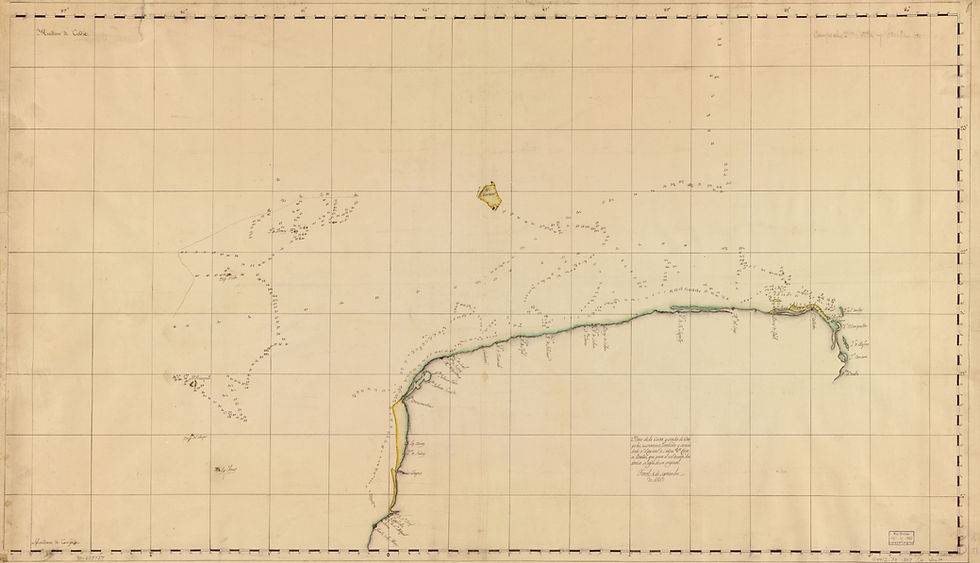
Isla Mujeres and the northern Yucatán coast on an 1807 nautical chart.
Ciriaco Cevallos and F. Cabarcos, 1807 · Library of Congress, Geography and Map Division, LC Luso-Hispanic World 576 · Public domain

Maya codex representation traditionally identified with the goddess Ixchel.
Wikimedia Commons · Public domain

Ancient Shrine, Island Mugeres, 1889.
Alice Dixon Le Plongeon · J. Paul Getty Museum / Google Arts & Culture · Public domain

A street in Isla Mujeres in the late nineteenth century, 1889.
Alice Dixon Le Plongeon · J. Paul Getty Museum / Google Arts & Culture · Public domain

Fisherman's Hut, Island Mugeres, 1889.
Alice Dixon Le Plongeon · J. Paul Getty Museum / Google Arts & Culture · Public domain

Hacienda Mundaca, a surviving landmark of nineteenth-century Isla Mujeres.
Photo: ImTurismo / Wikimedia Commons · CC0
From a Fishing Community to a Tourism Economy
Fishing remained central to Isla Mujeres well into the twentieth century and continues to influence island identity, food, family history, religious life, and the local economy.
The development of Cancún beginning in the 1970s transformed the northern Quintana Roo region. Isla Mujeres, already an established community and early tourism destination, became increasingly connected to a rapidly expanding international tourism economy.
Today, tourism is one of the island's principal economic sectors, alongside the continuing importance of fishing. The municipal development plan identifies tourism and fishing as the municipality's principal economic activities, with tourism now playing an especially dominant role.
Restaurants, hotels, vacation rentals, golf-cart companies, ferries, beach clubs, tour boats, diving and snorkeling businesses, retail shops, fishing excursions, and many other services now depend directly or indirectly on visitors.
The transformation has created prosperity and employment, but also research questions involving housing, transportation, environmental pressure, development, labor, inequality, language, public space, conservation, and cultural change.
.jpg)
Boats along the Isla Mujeres waterfront, 1980.
Photo: Gerd Eichmann / Wikimedia Commons · CC BY-SA 4.0
(1).jpg)
Playa Norte and the developed northern end of Isla Mujeres, 2018.
Photo: dronepicr / Wikimedia Commons · CC BY 2.0
A Community of Thousands Receiving Millions of Visitors
The contrast between the resident population and the visitor population is one of the defining features of contemporary Isla Mujeres.
Only about 14,000 people live on the island, yet municipal authorities reported roughly five million visitors between September 2024 and July 2025. During especially intense tourism periods, government officials have cited daily visitor volumes of approximately 30,000 people.
That means that on a very busy day, visitors can substantially outnumber the island's permanent population.
For residents, tourism is therefore not an occasional event. It is part of everyday life.
Visitors share roads, beaches, ferries, restaurants, shops, public spaces, conservation areas, and services with the people who live here. Tourism affects employment, language, transportation, housing, waste, environmental protection, politics, business decisions, and how island culture is represented to outsiders.
This is one reason Isla Mujeres is such an unusually productive setting for social research: large-scale global tourism meets a small, closely connected community within a remarkably compressed geographic space.
.webp)
The renewed Malecón Oriente and Paseo de las Sirenas, September 2026.
Source: Ayuntamiento de Isla Mujeres, September 9, 2026 · via Realidades Quintana Roo
Faith, Tradition, and Community Life
Isla Mujeres is also a closely connected community in which Catholic traditions remain highly visible in public and family life.
Religious observances extend beyond the church itself into streets, plazas, neighborhoods, boats, music, food, family gatherings, and public celebrations.
The patronal festivities honoring the Virgen de la Inmaculada Concepción include processions, gremios, vaquerías, cultural activities, religious services, and a maritime procession through the bay. Municipal accounts describe these festivities as important expressions of local identity and family cohesion.
December also includes neighborhood devotions associated with the Virgen de Guadalupe, part of a wider Catholic calendar that remains visible in island social life. Municipal records document local Guadalupe novenas alongside other community religious activities.
Another particularly distinctive tradition is the annual maritime procession toward Isla Contoy in honor of the Virgen de la Caridad del Cobre, patroness of fishermen and the national patroness of Cuba. Hundreds of island families, fishermen, and tourism workers participate by boat, connecting Catholic devotion with fishing heritage, maritime identity, and the island's longstanding cultural ties to Cuba.
For ethnographers, these traditions demonstrate something important: religion is not isolated from social life. It intersects with family, fishing, migration, identity, tourism, history, and community belonging.
.webp)
One of the siren sculptures overlooking the Caribbean at the Paseo de las Sirenas, 2026.
Source: Ayuntamiento de Isla Mujeres, September 9, 2026 · via Realidades Quintana Roo

Parroquia de la Inmaculada Concepción, Isla Mujeres.
Photo: Larry D. Moore / Wikimedia Commons · CC BY 4.0
A Seasonal Caribbean Environment
The island's social world is also shaped by the rhythms of the surrounding Caribbean ecosystem.
Each year, whale sharks gather in waters north and east of Isla Mujeres and nearby protected areas. The official observation season in the Whale Shark Biosphere Reserve runs from May 15 through September 17, and the animals' seasonal presence supports a substantial wildlife-tourism economy involving boat operators, guides, tourists, regulators, scientists, and conservation organizations.
Sea turtles also return seasonally to local beaches. Isla Mujeres maintains monitored nesting beaches and a municipal turtle camp, with nighttime patrols protecting nesting females and nests during the reproductive season. The 2025 program monitored beaches including Icaco, Media Luna, Bachilleres, and La Guadalupana.
In the Mexican Caribbean, green turtle nesting generally begins in May and continues into September, meaning that students conducting summer fieldwork are present during one of the most active periods of the sea-turtle reproductive cycle.
The region is also shaped by migratory birds, marine mammals, rays, reef fish, seasonal weather, tropical storms, and hurricanes.
Nature on Isla Mujeres is therefore not simply scenery. It structures economies, tourism seasons, conservation policy, livelihoods, public behavior, and research opportunities.
Reefs, Mangroves, Beaches, and Caribbean Life
Isla Mujeres sits within a biologically rich part of the Mexican Caribbean.
The surrounding environment includes coral reefs, seagrass beds, mangroves, lagoons, coastal dunes, beaches, and open Caribbean waters. Nearby Isla Contoy protects mangrove and dune ecosystems, important seabird habitat, sea-turtle nesting areas, fisheries resources, and the northern reaches of the Mesoamerican Reef system.
The island itself is characterized by coastal vegetation, palms, mangroves, iguanas, pelicans, frigatebirds, herons, tropical fish, rays, turtles, and many other species familiar to anyone spending time here. Government tourism resources specifically identify beaches, lagoons, reefs, mangroves, and tropical flora and fauna as defining parts of the island environment.
For IFS students, ecological questions rarely remain purely ecological.
Reef conservation becomes connected to sunscreen use, tourism education, business practices, and regulation. Sea-turtle conservation becomes connected to beach use, lighting, tourism, development, and public awareness. Whale-shark conservation becomes connected to livelihoods, visitor expectations, boat operators, regulation, and environmental ethics.
That intersection between environmental systems and human behavior is exactly where ethnography becomes particularly useful.
Safety and Everyday Independence
For IFS students, Isla Mujeres is generally a comfortable place in which to live, move through the community, and conduct independent fieldwork.
Violent crime is uncommon in the everyday experience of IFS students, and the small scale of the island means that students quickly become familiar with neighborhoods, transportation routes, businesses, research locations, and community contacts. The municipal government currently describes Isla Mujeres as a leading municipality in Quintana Roo for public safety and has continued investing in policing, surveillance, emergency response, and public-safety infrastructure.
IFS does not present safety as an absolute guarantee. No community is entirely without risk, and students are expected to use ordinary situational awareness and follow program guidance, particularly when traveling at night, using the water, or participating in activities away from familiar areas.
Students live in secure, professionally managed residential properties, typically with gated access and individually secured accommodations. Local property management is available when assistance is needed.
Just as important, IFS Director Dr. Todd G. Pierce has lived full-time on Isla Mujeres for more than fifteen years. Students therefore have access to someone with long-standing familiarity with the island's neighborhoods, transportation, institutions, community networks, and everyday rhythms.
For many students, Isla Mujeres quickly becomes a place where they feel comfortable moving independently while developing the judgment and situational awareness expected of field researchers.
A Living Field
Isla Mujeres is not simply a beautiful place to conduct research.
It is a historically layered, culturally distinctive, environmentally dynamic community shaped by Maya history, migration, fishing, Catholic traditions, Caribbean maritime exchange, international tourism, conservation, development, and continuous interaction between residents and visitors.
Within only a few miles, students encounter health clinics, schools, fishing families, tourism businesses, artists, migrants, conservationists, religious celebrations, government institutions, beaches, reefs, wildlife tourism, residential neighborhoods, and international visitors.
The connections among those worlds are what make the island so valuable ethnographically.
A biological question about sea turtles may become a question about tourism, beach access, business, and conservation policy. A public-health question may become a question about family networks, trust, education, or transportation. A language question may become a question about tourism and employment. A cultural question involving Ixchel may become a study of heritage, religion, commerce, and differences between local and tourist understandings of Maya identity.
IFS therefore teaches students to understand Isla Mujeres as the field, not the topic.
The island provides the setting in which researchers learn to recognize how history, environment, economics, institutions, culture, policy, and human relationships meet in everyday life.
And because IFS has worked within this community for more than a decade—and its director has called the island home for more than fifteen years—students enter a field school with established relationships, local knowledge, and a continuing commitment to the community in which the research takes place.

Whale shark in the waters off Isla Mujeres.
Photo: MarAlliance2018 / Wikimedia Commons · CC BY-SA 4.0

Green sea turtle on Isla Mujeres, 2008.
Photo: Manfredwinslow / Wikimedia Commons · Public domain

Caribbean waters off southern Isla Mujeres at Garrafón.
Photo: Kirt Edblom / Wikimedia Commons · CC BY-SA 2.0

Juvenile brown pelican among the fishing boats of Isla Mujeres, 2017.
Photo: Larry D. Moore / Wikimedia Commons · CC BY 4.0

Mayor Atenea Gómez Ricalde with community members at the inauguration of the Paseo de las Sirenas, September 9, 2026.
Source: Ayuntamiento de Isla Mujeres, September 9, 2026 · via Realidades Quintana Roo