The Isla Mujeres
Ethnographic Field School
About I.F.S.
Why Ethnography Matters
The problems people investigate rarely exist in isolation. Health is connected to families, work, institutions, belief, policy, and environment. Conservation involves livelihoods, tourism, regulation, and competing uses of resources. Law operates through interpretation, enforcement, power, and everyday encounters with rules. Businesses depend on workers, customers, organizations, and local economies.
Ethnography helps researchers understand these connections as they unfold in people’s lives. Students learn to listen carefully, recognize patterns, connect seemingly separate pieces of evidence, question assumptions, and revise their understanding when new findings change the picture.
Anthropology provides the research tradition, but the question may come from medicine, public health, psychology, sociology, law, environmental science, conservation, business, architecture, education, policy, or another field. Research possibilities include community health, tourism economies, gender and inequality, environment and development, globalization, and relationships between people and place.
Whatever you study, once people enter the problem, there is a human dimension to understand.
Learn Ethnography by Doing Ethnography
Established in 2013 on Isla Mujeres, Mexico, the Isla Mujeres Ethnographic Field School (I.F.S.) provides intensive ethnographic research training through real projects, direct mentorship, and sustained engagement with people and their everyday lives. Our mission is to prepare students to investigate meaningful questions with methodological rigor, ethical judgment, and intellectual independence. Directed by cultural and medical anthropologist Dr. Todd G. Pierce, I.F.S. connects academic instruction with the responsibilities of conducting research and communicating what it reveals.
We welcome committed students at different stages of academic development, from undergraduates beginning their research training to graduate students, postdoctoral researchers, and independent scholars. Some arrive with substantial anthropology experience; others bring questions from another discipline or have taken only an introductory course. The standard is high. The starting point is individual. Each student’s project, responsibilities, and mentorship reflect their preparation and goals, with close guidance supporting increasing independence.
For more than a decade, I.F.S. student work has developed into conference presentations, peer-reviewed publications, senior theses, graduate research, and further fieldwork. Our approach connects preparation, field research, analysis, and scholarly communication. Students learn what happens when a research plan encounters actual people, relationships, institutions, practical constraints, ethical questions, and unexpected evidence—and how to respond with care and sound judgment.
Rule #1: It’s All Data
Ethnographic fieldwork is not limited to formal interviews, scheduled observations, or the moments when a researcher deliberately sets out to collect data.
One of the central principles of FieldCraft is simple: It’s all data.
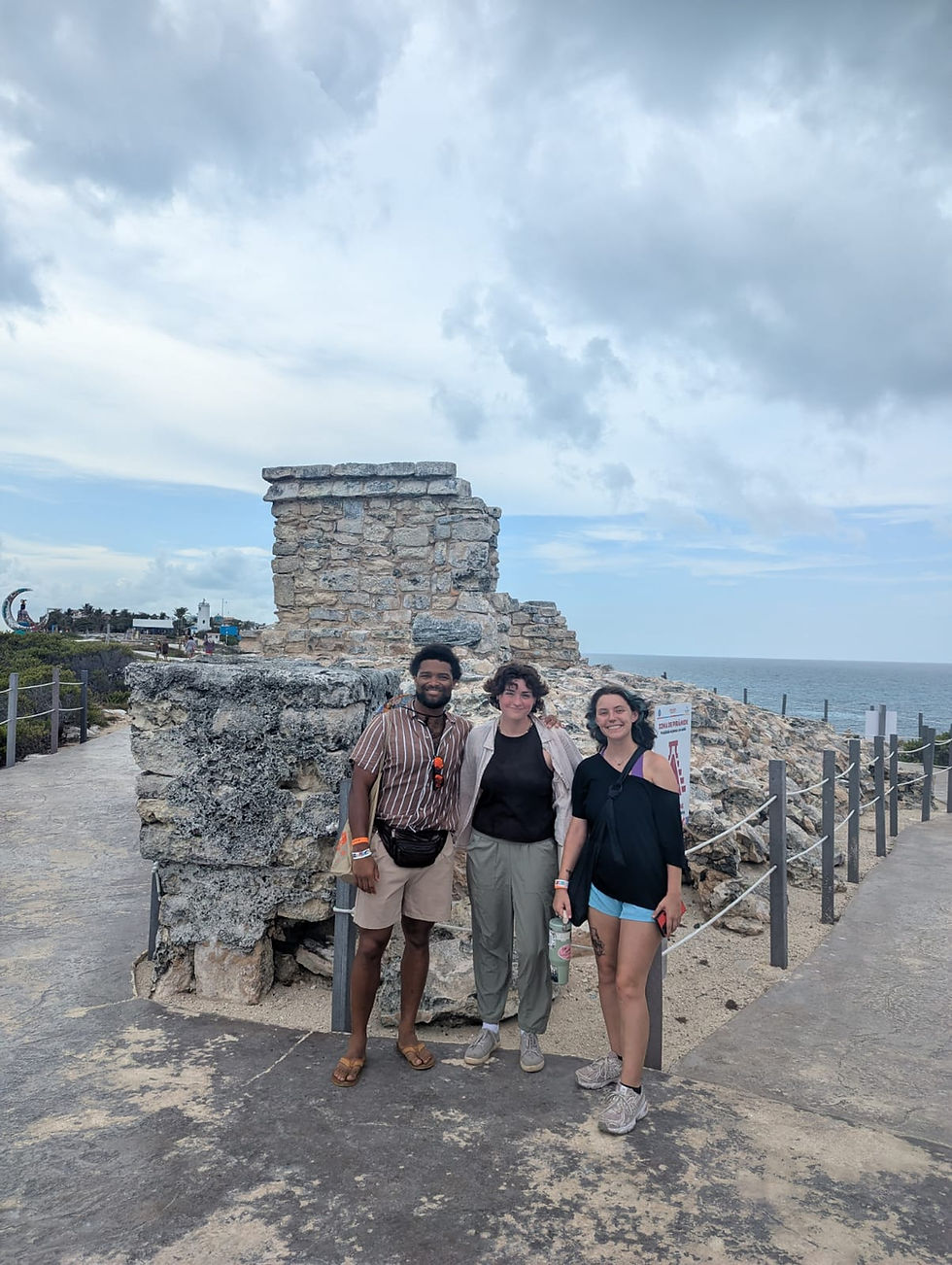
Students living and conducting research on Isla Mujeres are constantly encountering the social world they are trying to understand. A conversation in a taxi, a trip to the grocery store, a morning at the gym, a neighborhood restaurant, a church service, a walk through Centro, a beach cleanup, or an unexpected interaction in the street may reveal patterns, relationships, routines, values, tensions, and questions that formal research alone might never expose.
This does not mean that every casual encounter automatically becomes formal research data, or that ethical responsibilities disappear outside a scheduled interview. It means that ethnographers learn to remain observant—to recognize that the field does not switch off simply because the formal research activity has ended.
IFS is therefore a lived ethnographic experience. Students are not simply studying Isla Mujeres from the outside. They are living within the community, alongside people carrying out their own everyday lives, and learning how to see those experiences ethnographically.
Director & Lead Instructor
Dr. Todd G. Pierce is the founder and director of the Isla Mujeres Ethnographic Field School and serves as its lead instructor and research mentor. A cultural and medical anthropologist with more than three decades of ethnographic research experience, he holds a Ph.D. in Cultural Anthropology from The Catholic University of America, an M.A. in Social and Cultural Anthropology from Yale University, and a B.A. in Cultural Anthropology from the University of Connecticut.
Dr. Pierce has lived full-time on Isla Mujeres for more than fifteen years. The island is not simply the location of the Field School; it is his home. Many of the stakeholders, cultural consultants, research participants, community organizations, and collaborators with whom IFS students work are members of the same community in which he lives.
Since founding IFS in 2013, Dr. Pierce has worked directly with students to develop independent research projects, navigate research ethics and field methods, analyze qualitative evidence, and carry fieldwork forward into senior theses, graduate research, conference presentations, publications, and continuing scholarly work.
His approach to mentorship is highly individualized. Students enter IFS at different stages—from undergraduates conducting their first independent project to graduate researchers and Ph.D. holders—but all are expected to approach the work with seriousness, ethical responsibility, and intellectual rigor. The purpose of direct mentorship is to meet each researcher where they are academically and move their skills, confidence, analytical ability, and independence further forward.
Individual Mentorship and Collaborative Research
Research development can begin as soon as a student is accepted. Early applicants have more time for one-to-one discussions, background research, and proposal development before the formal session begins. This preparation helps students arrive with a more focused inquiry and a clearer understanding of what their project will require.
Students may participate as Principal Investigators, designing and leading a focused project under guidance, or as Research Associates, contributing to research through data collection, analysis, and other project responsibilities. These roles can overlap: students may lead one inquiry while contributing to another. Individual mentoring and research team meetings support the work from initial design through interpretation and writing.
Depending on the project’s requirements and feasibility, participation may involve a full stay on Isla Mujeres, a shorter period in the field, or remote research. Each format requires meaningful research responsibilities and sustained engagement with the project.
Academic Practice and Ethical Responsibility
Students engage with the practical, analytical, and theoretical dimensions of ethnographic inquiry through lectures, discussions, research meetings, and their own projects. Training includes participant observation, open-ended and semi-structured interviewing, fieldnote writing, and analysis, with archival research and other qualitative or quantitative techniques incorporated where appropriate. Throughout this work, students connect evidence with theory and examine how their position, assumptions, and relationships influence what they learn.
Ethical responsibility runs through the entire research process. Students consider informed consent, confidentiality, participant identification or anonymity, and the consequences of representing other people’s lives. They learn to establish rapport, engage different perspectives, and make thoughtful decisions as circumstances change. Applied research also asks how findings may inform practical decisions and respond to concerns that matter to communities.
From Research to Scholarly Work
Students develop a portfolio that documents their research and intellectual growth. Depending on their role and project, this can include fieldnotes, analytical writing, a reflexive assessment of their research practice, a journal-style manuscript and abstract, and a condensed conference-style paper and abstract. Professional development also includes preparation of an academic curriculum vitae and guidance on presenting research to different audiences.
Writing and analysis begin during the research process, with mentorship supporting further development toward presentation and publication. Students leave with practical research experience, evidence of their scholarly work, and a stronger foundation for advanced study, professional practice, and future inquiry.
"The active, real-world setting of the classroom provided valuable experience to my undergraduate education. After participating in this program I feel confident in a variety of ethnographic research methods as well as how to improve future research."
- Brooke

"The freedom to design and address your own research question is hugely empowering as a student. Isla Mujeres is undeniably safe, and the residents of the island are overwhelmingly warm, friendly, and accommodating." - Matt

"Having hands-on ethnographic work, captivating coursework and discussions with Dr. Pierce and visiting anthropologists, as well as insightful conversations with community members made attending this field school an experience I will always value." - Nev